Anna Livia’s letter
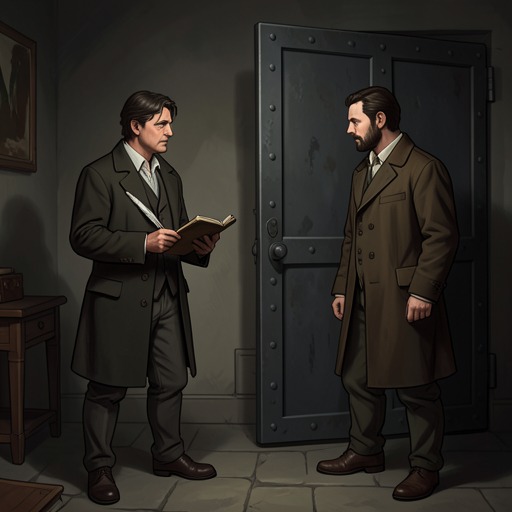
Finnegans WakeAnna Livia’s letter is a damaged document whose uncertain contents make it a meeting point for discovery, interpretation, gossip, and public judgment. Found by Belinda of the Dorans in a midden and transformed by burial in orange-flavoured mud, it is treated as an ancient relic and repeatedly reconstructed from material traces: paper, stain, handwriting, perforations, and competing accounts. The letter does not settle meaning so much as expose how meaning is made, as readers, witnesses, and narrators turn fragments into stories.
Discovery and Material Remains
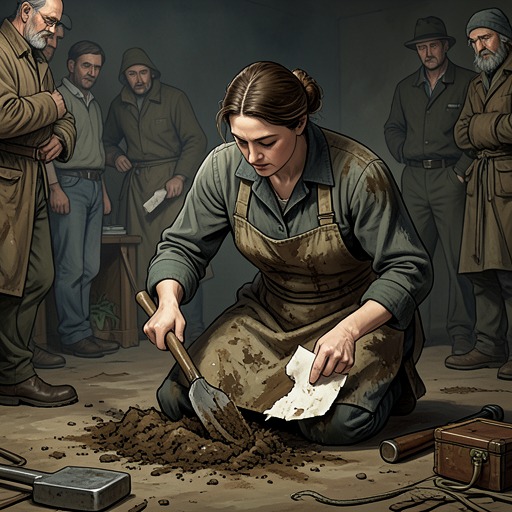
The letter’s recovery is set amid a cold, unsettled season: midwinter is approaching, while spring is only promised. A child finds an odd hen scratching at a midden or dump, later changed into an orangery. Its beak brings up fragments of orange peel, remnants of an outdoor meal left by an unknown person hiding or passing through in the distant past. In the same disturbed ground, the hen uncovers the letter. The scene joins the document’s material history to the book’s recurring traffic between buried evidence and newly told histories: what survives does so by chance, mixed with refuse and brought to light by an animal rather than an official investigator.
Belinda of the Dorans, an elderly hen, is identified as the bird at the center of the discovery. At noon she scratches at what looks like a substantial sheet of letter paper, originally sent from Boston. Its domestic fragments suggest an ordinary correspondent’s message: greetings to a dear recipient, reports that Maggy and everyone at home are well, concern about the Houtens and the general’s elections, wedding cakes, and news of Father Michael’s funeral. The sign-off includes affection and kisses. Yet even this legible-seeming residue is tangled: names and phrases blur into one another, and the letter’s intimate, commonplace contents survive only in partial, unstable form.
A tea stain marks the sheet as a purported relic of ancient Irish pottery, likened to a familiar class of decorated ware. The narrator presents that classification with irony, noting the care taken to sign the page away as an authentic object. The stain is thus more than damage: it becomes an apparent mark of provenance, a clue that can lend the letter historical authority while also inviting suspicion about how such authority is manufactured.
Damage, Reading, and Interpretation
The letter is explained through the analogy of a photographic negative. If a horse’s negative melts while drying, the resulting image becomes grotesquely distorted; likewise, the letter’s residence in the heart of the orange-coloured mud mound is said to have partly obliterated it. Features nearer the surface swell, while those farther back recede and become harder to discern. This account makes damage a principle of reading: the surviving image is not a transparent record of an intact original, but a warped presentation in which proximity, loss, and the reader’s need for a lens govern what can be seen.
The text also makes the reader’s uncertainty part of the experience. A voice describes the remains as a bewildering sample jungle, where even the apparent meaning of the material resists confident recovery. The injunction “Lead, kindly fowl!” turns the hen into a guide through this thicket of evidence. Her natural work of laying, loving, and sheltering eggs becomes a comic analogy for textual reproduction: she is associated with propagation, incubation, and the passage from one generation to another. The letter’s recovery consequently links damaged writing to the possibility of renewed life, while refusing to promise that interpretation will restore a single, undistorted original.
A later account of a document in the Tiberiast duplex offers a sharper forensic counterpart. Its source is described as an unpunctuated script, but inspection of the reverse against a lit rush reveals that the sheet has been pierced by a pronged instrument. The holes are read as four distinct marks of interruption, ranging from a request to stop to an emphatic plea. The inquiry then follows those punctures as clues, connecting them to a pattern of perforations and a playful fowl. The episode extends the letter motif beyond ordinary words: writing can be made by cuts and holes as well as by ink, and interpretation depends on treating damage itself as a legible, though equivocal, sign.
Authorship, Evidence, and Public Voices
The account insists on the physical presence of a woman’s handwriting. Rather than relying only on hearsay about an anomalous letter, the narrator claims to have a copy of her hand close at hand and notes a young watermark on the paper. But this apparent precision does not secure a stable authorial identity or final text. The documentary evidence is embedded in exuberant wordplay, shifting registers, and assertions whose confidence repeatedly exceeds what the fragments can prove. The letter is simultaneously presented as an object that can be inspected and as a story continually remade by those who inspect it.
That instability echoes the public stories told about HCE. One account describes him crossing a park in conspicuous outdoor clothing when he meets a man with a pipe, who asks him a question about the time. HCE produces a watch and answers by reference to the church bells; he then makes a statement about an accusation and a person beneath him in standing. The encounter is retold as reported speech, reconstructed from successive accounts and cast as a lasting, rhythmic saying. The letter’s world is therefore not separate from public rumor: both documentary writing and remembered speech are assembled from partial testimony, edited into memorable form, and circulated as evidence.
The wider circulation of Hosty’s ballad makes that process public and performative. At an old tollgate, a crowd sings a refrain that repeatedly renames its subject, cycling through variants before settling on Persse O’Reilly. The singers ask and answer one another, then break into a choral refrain; the performance ends amid the crash of glass and a burst of sound-play. As with the letter, a person or event becomes a shared text through repetition, variation, and collective handling. The song’s open, noisy performance contrasts with the private letter’s intimate address, but both show how unstable material can acquire public force once it passes among voices.
A procession of supposed witnesses and commentators further complicates the case. A dustman is asked about the controversy and responds in the language of a nullity suit; a driver offers a blunt judgment about HCE’s standing; other speakers contribute legal, religious, sensational, or comic opinions. Their testimony does not converge into a reliable verdict. Instead, the sequence dramatizes a community making and contesting its account through incompatible speech genres. The letter’s evidentiary problem thus belongs to a broader culture of allegation, where the public record is less a settled archive than a chorus of interested voices.
A Text Without a Final Closure
The narration openly questions whether the recorded outrages against a staunch figure ever took place, observing that some reports may use truth sparingly and that many alleged events are denied as well as affirmed. It imagines the accused fleeing to a distant refuge across the sea, then returning to a land where inhabitants rise against him and make him answer for their sins. These possibilities are not presented as a securely established sequence; they show how accusation can branch into further narratives of flight, return, persecution, and judgment. The letter belongs to this same uncertain landscape, where documents prompt stories rather than bringing them to an end.
Even the work’s later cues preserve recurrence rather than closure. A heading announces another episode of the book, after which the prose turns to the fear concealed behind a tribal stammer and to the glory of a wake seen from a bride’s perspective. Elsewhere, a brief scene imagines a desire that becomes another person’s despair and a beauty that becomes another’s grief; the speaker then says that the figure has grown back into his baseness despite his remonstrance. These fragments do not resolve the letter’s contents. Instead, they keep its pattern in motion: exposure and concealment, the return of old stories, and the transformation of private traces into public meanings that remain open to revision.